
Our first piece of portable solar was a foldable 80-watt solar bag from Offgrid Tech – small, compact, and nicely soft, with no sharp edges, so we could even lay it on the car roof. As handy as that was, it never had much punch: we rarely saw the full 80 watts. And after just a year and a handful of outings, it suddenly quit – somewhere a cable or contact had failed, the kind of thing you can't fix without fully taking the bag apart. That made it clear to us: we needed something sturdier, a proper hard-shell solar suitcase. That's how we landed on Renogy.
The format isn't especially common, and when we bought the suitcase a few years ago it wasn't cheap either – around 200 euros, and only an offer made it affordable for us. These days suitcases like this have gone a bit out of fashion, and Renogy barely sells it anymore – but you can now find it for around 90 euros.
The key specs at a glance:
| Specifications | |
|---|---|
| Power | 100 W (2× 50 W, monocrystalline) |
| Open-circuit voltage | 24.3 V |
| Optimum voltage | 20.3 V |
| Weight | 9.3 kg |
| Folded size | 63 × 51 × 7 cm |
| Connector | MC4 |
Built tough
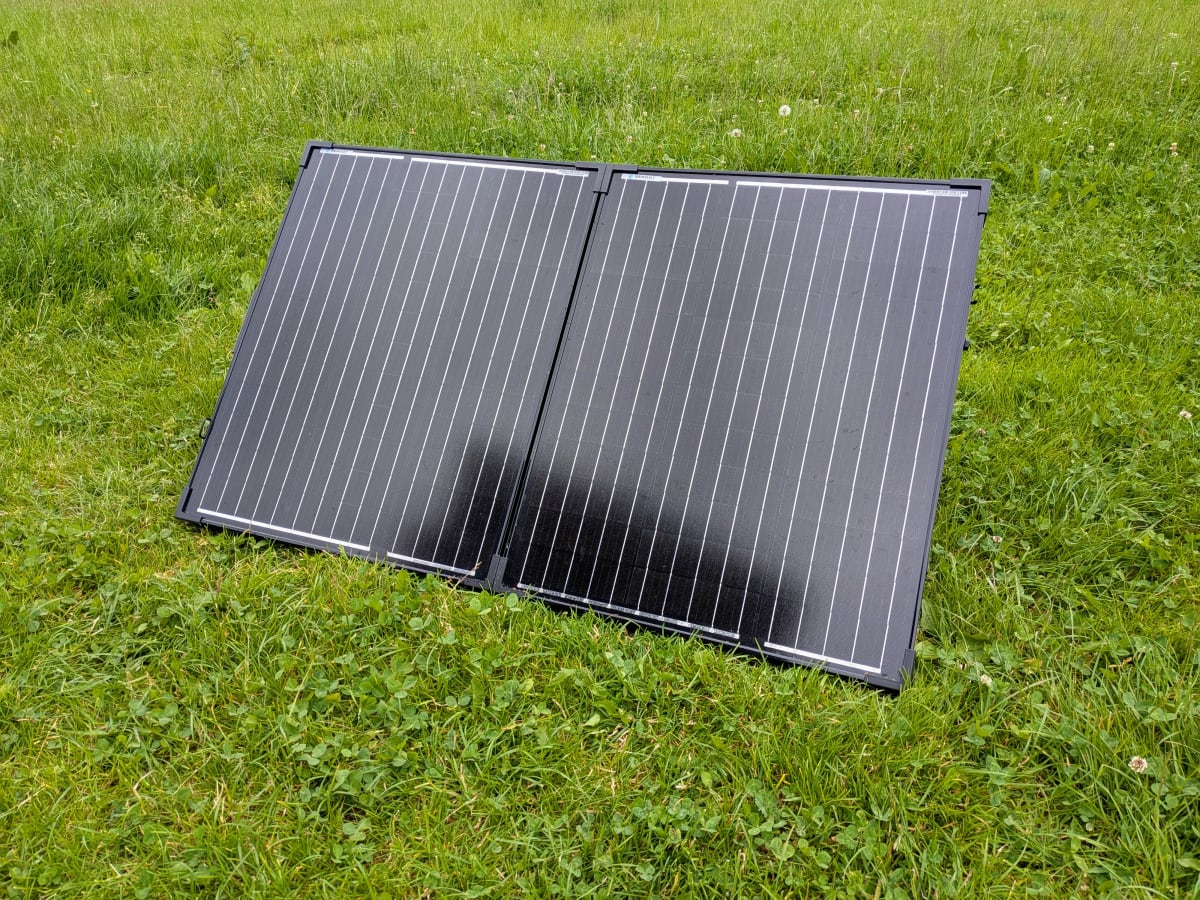
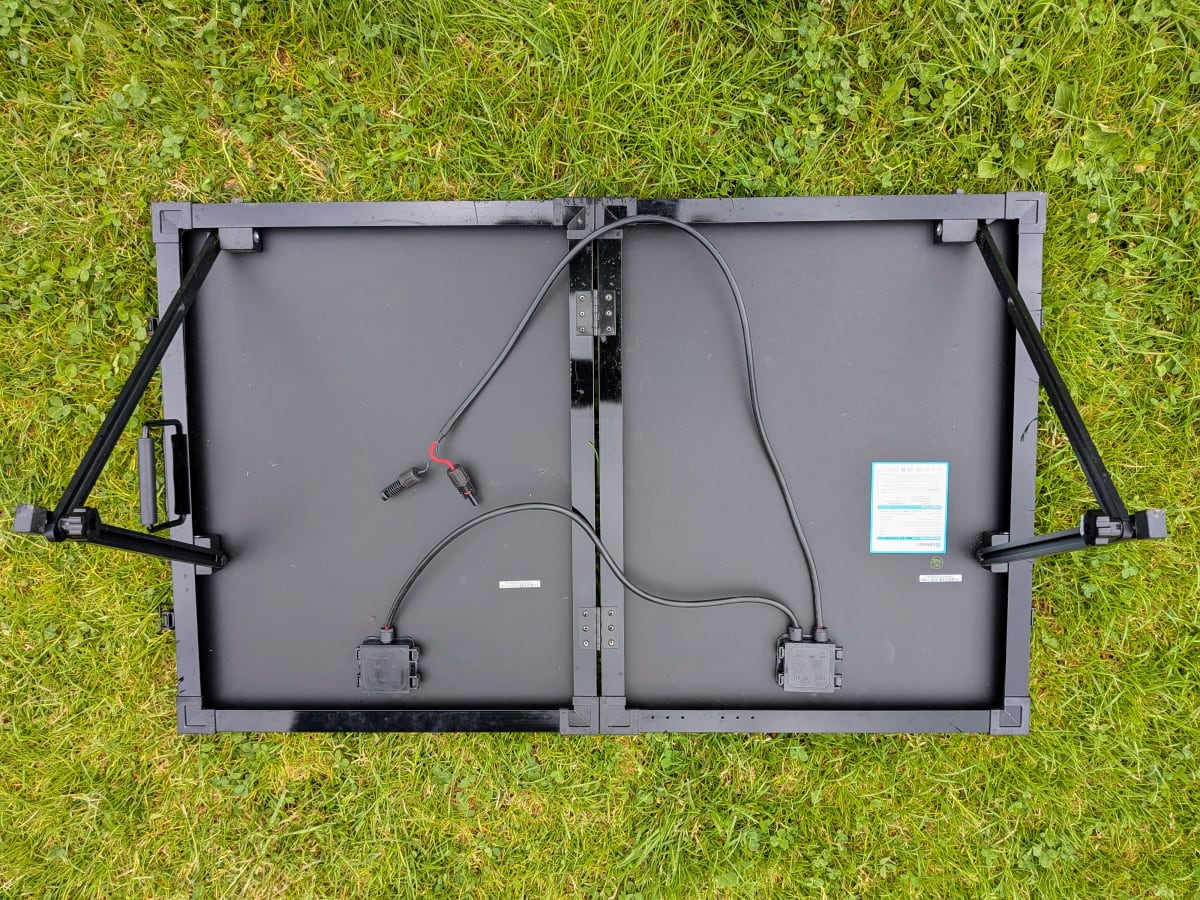
The very stability the solar bag lacked is exactly what the suitcase delivers. It's solid through and through: a classic hard-shell solar panel whose thick supplied cables lie out in the open, where nothing can snag or chafe anymore. Folded up, the suitcase closes on massive hinges, the cables sit protected inside and the modules face out – it feels genuinely robust. And so nothing gets knocked about, there's a sturdy case that protects the whole thing well in transit. Our impression is that it should last for many years.

Heavy and bulky
The price for that solid build is weight and bulk. At 9.3 kilos the suitcase is a much bigger, heavier affair than the old solar bag, harder to transport and thirstier on storage space. Quickly propping it on the car roof or behind the windscreen is barely an option either – because of the hard edges it tends to end up on the ground for us, or at most carefully on the roof so nothing gets damaged.

Teamed up with the battery box
We ran the suitcase off our self-built battery box. Our version deliberately comes without a charge controller – which suits us fine, since the regulation lives in the battery box anyway. And the combination worked out great: the suitcase's output pairs nicely with the box's small battery. The handy part is that you can either set the battery box outside or leave it in the car and just run the cable out – that always worked reliably for us.
Verdict
We're thoroughly happy with the suitcase itself: robust, reliable, and a great team with our battery box. We still didn't keep it in the end – and that wasn't down to the product. The general catch with a suitcase like this is that at every spot you have to set it up, angle it, and bring it back to safety at night. That effort became too much for us over time, so we decided that from now on the solar panel simply belongs fixed to the roof. That's why we passed this suitcase on as well. For anyone after a flexible, sturdy solution, though, it's a full recommendation – even if it wasn't the lasting answer for us.