The Bluefin Cruise 15 Tandem is an inflatable stand-up paddleboard for two people: 15 feet long, so a good four and a half metres, with three fins at the tail and – on our model – two kayak seats included. We bought it in 2022, and it has come along on quite a few trips since.
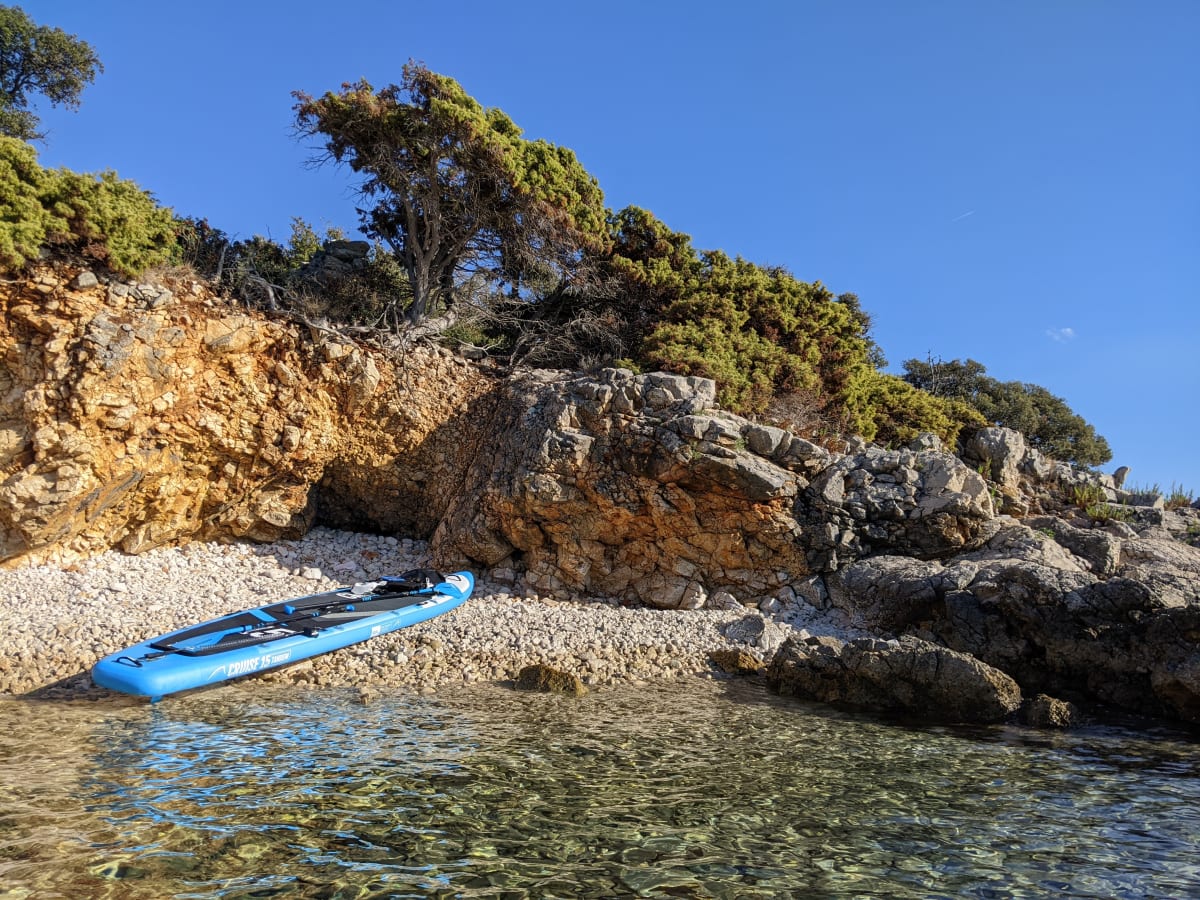
We mainly want to tell you about our own experience here, not repeat the spec sheet. You will find all the details at the manufacturer:
What you will find there now, though, is the successor, which is called simply the Tandem 15' – more on what changed at the end.
How we got into SUPs in the first place
It started with Susi suggesting we could borrow SUPs from her employer. So we did, and it was really cool. Two Fanatic boards that worked wonderfully, and each of us was out on one alone.
After that it was clear we wanted our own. So we borrowed one more from friends to test, an Itiwit from Decathlon. And there we noticed that it sat sluggishly in the water and hardly tracked at all – the fin did very little steering. We cannot say whether that was a one-off: it was a cheap standard board, and one of them alone is not a verdict on the brand.
Then came the actual idea. When we were out with two boards, we sometimes tied them together so we could lie on them next to each other. And at some point we thought: one big board for both of us would be much nicer. Then we could have a picnic together and take breaks together, instead of paddling alongside each other.
There are a number of such tandems, we looked at several, and at first we did not want to spend too much money. So we ordered an Aztron Nebula. We unpacked it, looked at it – and thought at first glance: badly made. There was a wild, very roughly stitched seam right down the middle of the board. I packed it up again immediately and we sent it back. After that the decision was made to buy something proper, and that is how we ended up with the Bluefin.
The first impression
Ordered, unpacked, set up, tried out – and immediately: wow. The board sits beautifully in the water and tracks really well. After the Itiwit that was a difference like day and night.
There are three fins at the tail: a big one in the middle and two small ones beside it. With all three fitted the tracking is excellent, almost too good, because turning becomes very hard. That is why we now usually fit only the big centre fin. It is completely enough. You can paddle straight ahead forever on one side only if you add a slight C-stroke.
The pumping – the tedious part
And here comes the one thing that is genuinely hard work: you have to pump forever. Inflating is tedious with every SUP, but this is a big board with a lot of air volume, and it needs 15 to 18 PSI. Doing that alone in one go is practically impossible – unless you are Hulk or Popeye. We take turns, with breaks in between, and then it simply takes a while. In return it runs beautifully once there is enough pressure in it.
The included pump works well. It has a double-stroke and a single-stroke mode, and the order is worth knowing: start in double-stroke mode to get a lot of air in, and switch to single stroke as soon as it gets hard. Then it only pumps on the way down, not on the way up. That way you can use your body weight, need almost no force pulling up, and get on much faster.
Two on board
Once the board is inflated, though, the effort is quickly forgotten. The two of us fit on it wonderfully and we have been out on it together a lot. There is really a lot of room: we can both stand on it, we can both sit on it, and with the two paddles it paddles beautifully.
We have also tried the kayak configuration, which lets you paddle much longer at a stretch. It does not just come with two kayak seats – the paddles can be converted as well. Either into two proper kayak paddles with a blade at each end, or into two single SUP paddles. That is really cleverly done.

The board is well equipped otherwise too: pump, a waterproof container, repair and spare parts. There is a handle in the middle so you can carry it alone – it is still a big board, of course, but it works. At the front there are bungees for strapping things down, plus a small camera mount, a hook and various lash points.
The backpack is too small
Which brings us to the biggest criticism, the thing that has annoyed us again and again: a backpack is included, but it is simply too small. The board does not fit in properly. With some effort you get it in somehow, but it is still tight – that was sloppy work. Maybe there is a trick to folding it a particular way; we have not found it. By now we keep the board permanently outside the backpack, because we no longer feel like fiddling with it every time.
And the pump cannot suck air out
The second point concerns the pump again. It inflates well, but it cannot suck air out – and that means packing up takes a trick. You should really fold the board starting from the fin box, but that is exactly where the valve sits. So you first let the air out from nose to tail, close the valve again, and then roll up from tail to nose. Even then some air usually stays inside, and you end up with it sitting in the nose. If you want to do it properly, you basically need a second pump that can suck air out – we sometimes use a different one for that.
The compressor we no longer take along
Because the pumping is such an effort, we also bought Bluefin's compressor. It does work well. At the start it hums along nicely in air-pump mode, but as soon as the pressure rises it switches to compressor mode – and then the thing really makes noise. It is seriously loud.
It has no battery. So you run it off the car or bring a big, strong battery. It runs on 12 volts, and we were in fact able to run it off our Battery box, which worked well. You just have to haul that down to the beach or over to the pitch.
In the end it was not the technical side that convinced us to leave it at home, but the noise. We find it unpleasant to make that kind of racket ourselves, and it annoys us when others do it on the campsite. When everyone heads to the beach in the morning and inflates their SUP like that, it is simply a lot of noise. By now we are convinced: better to pump by hand.
Out and about: why all of this is worth it
We first tried it at our local quarry lake. The first time it really came into use was on our trip to Croatia, in Premantura and on Pag, and after that on many more tours.
And that is where we understood what a SUP can actually do. There was a lot going on at the campsites and it was quite loud, and here in Bavaria too, at Lake Chiemsee for example, the beach sections are often small and rather crowded. But as soon as you have pumped it up and gone onto the water, none of that matters. There is almost always room on the water. You can set off, explore the area and reach beaches that are otherwise hard to get to. Wherever we went and however busy it was: inflate, get on the water, and we had all the freedom we wanted.

In Croatia this was wonderful. Paddling along the coast, landing at different beaches and small islands, and all that lovely clear water you can jump into from the board again and again. Sometimes we paddled to the next village with the SUP, landed there, bought a few things and came back. It opens up completely new routes.
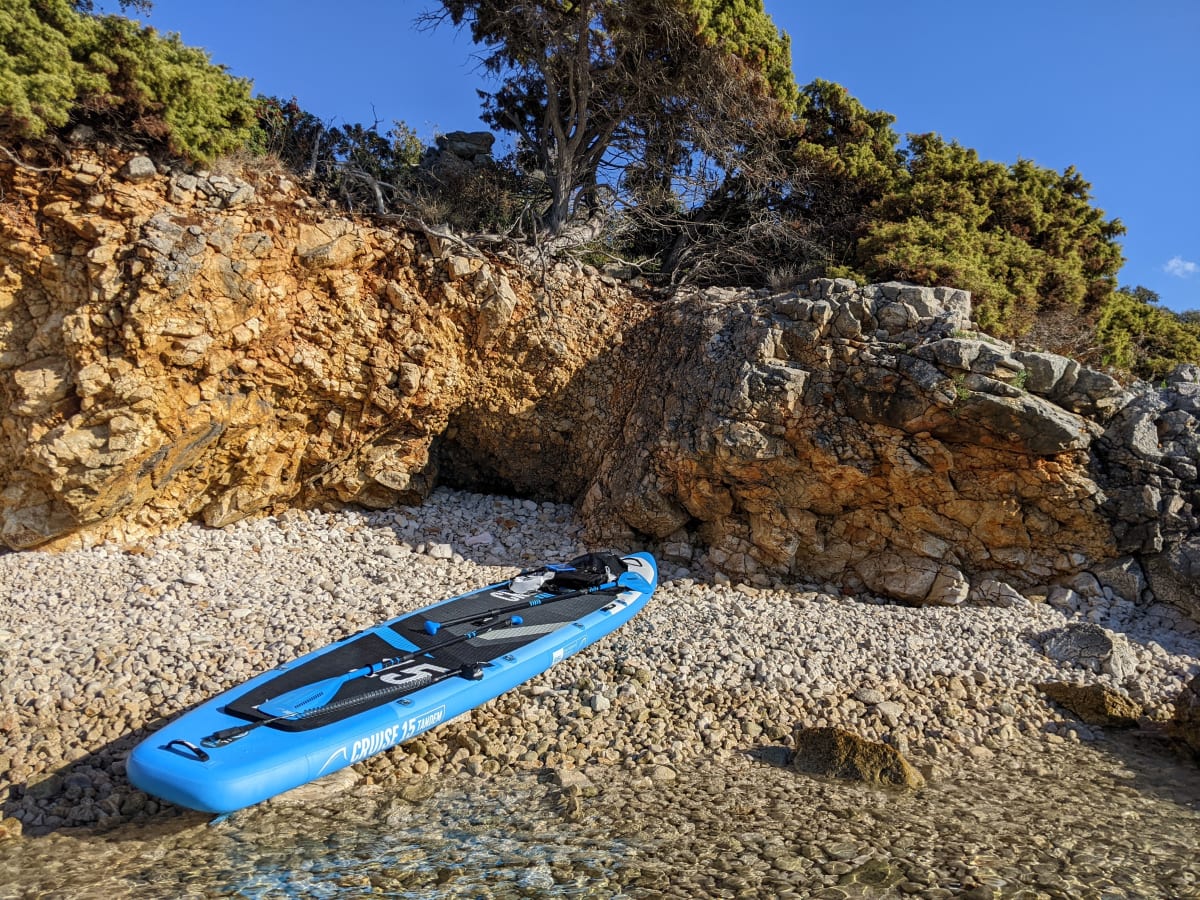
Waterproof dry bags are useful for this. They let you take some food along, keep the car key safe and maybe fit in a T-shirt as well. We had a small dry bag and a bigger backpack with us, sometimes both, sometimes neither – depending on how much had to come along. There is genuinely room for that on the tandem.
One small tip on the side: it is quite practical to simply leave the SUP inflated, for example leaning against the car to dry. It holds the air for quite a while; if it sits around longer, you should top it up before the next trip. On very hot days it should not lie in full sun for too long, though. You do have to keep in mind that it might get stolen – on a campsite we feel reasonably safe about it, but that does depend on where you are.

A word on safety
On bigger lakes and at the sea we only go out a little way and then mostly paddle along the beach. Anyone going further out should definitely wear a life vest. A SUP is not a safe boat: it can lose air or break, and then you have to expect to swim a longer distance. We are usually out without a vest and therefore deliberately stay close to shore, so that we would never have to swim more than perhaps 50 to 100 metres. If we really wanted to head out, we would put life vests on.
Corsica, three of us
Considerably later, on Corsica in 2026, we were on the SUP with our son Noah for the first time. We had tried once before, when he was almost two, but he did not want to. For a long time he was rather afraid of the water and did not want to get on the board either. On Corsica it worked.

And this is where the tandem plays to its full strength. Susi, me and Noah as well, we all fit on it with room to spare. A really nice family outing, on which we also headed for one beach or another.
Noah is quite fidgety and does not like sitting still – but on the SUP he really did sit there for half an hour just looking around. He keeps his feet in the water the whole time, to cool down and because he likes it. That does cost something: feet in the water mean extra drag, you have to paddle harder, and since one of us has to watch Noah, only one of us paddles at a time. We still made good progress.
For Noah we have a very simple life vest that does not really count as safety equipment. You must not go far out with it. Because we stay near the beach anyway, that was fine for us: 50 metres is manageable even with a child if it comes to it, and if we noticed that something was wrong we would head straight for the shore. Staying close to the shore was always important to me, and that makes the whole thing feel safe.

Once I also went out with the SUP alone. That works fine, you make good progress, though it is of course unwieldy. The big drawback of the long board is turning again. It is best to stand in the middle for paddling straight and step back to turn – then the nose lifts and the turning radius gets much better.
Conclusion
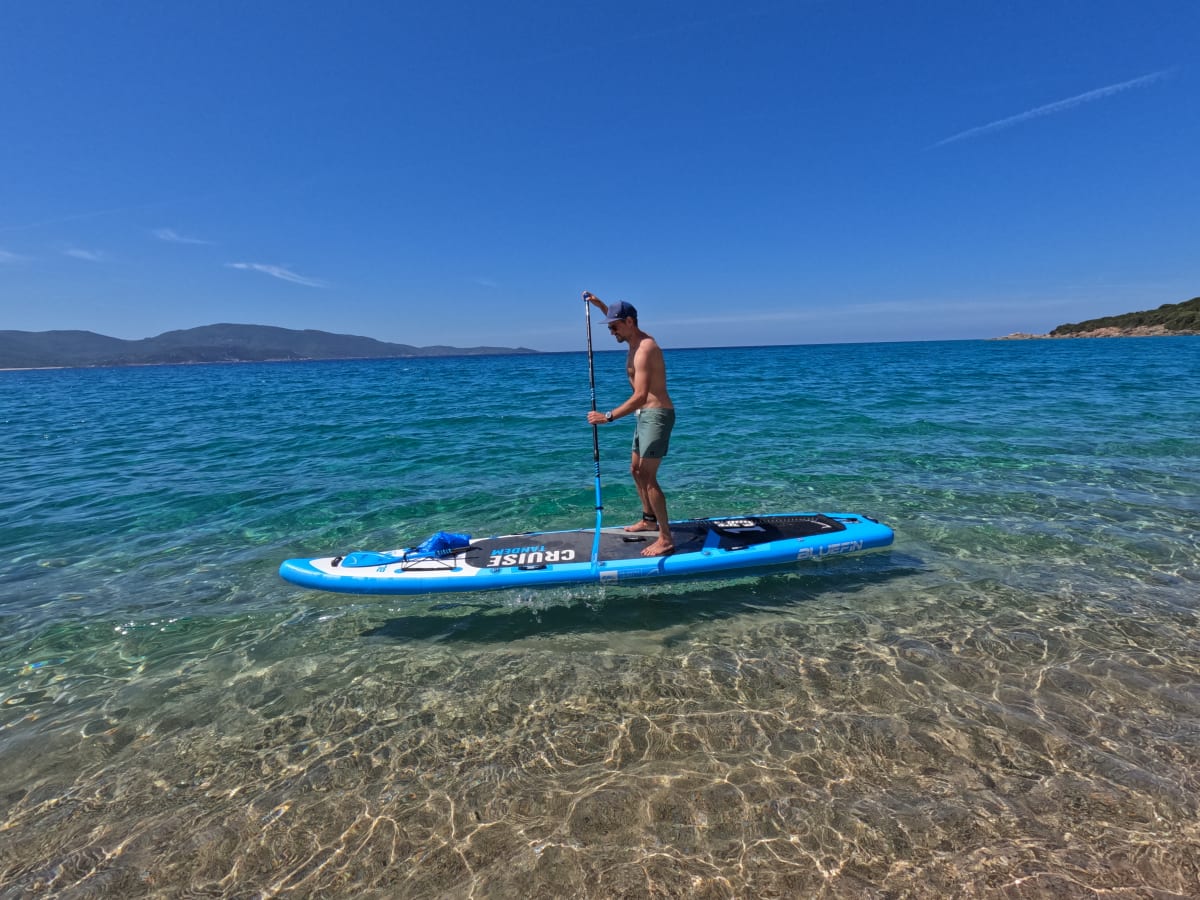
All in all a great piece of kit that we have been very happy with for years. There are a few flaws, and we have written them down honestly above: the undersized backpack and the pump that cannot suck air out – plus the long inflating, which simply comes with a board this size. The board itself does exactly what we bought it for. It tracks beautifully, it carries the two of us and by now the three of us, and it has opened up bays and beaches we would otherwise never have reached. One of the best purchases we have ever made.
Update 2026: The successor ships from 19 August 2026, and we find several of the changes very sensible indeed. It has only one fin instead of three – which is exactly the setup we ran our board in the whole time anyway. There are two leashes instead of one, and going by the product photos the second one attaches to the centre handle. A waterproof phone pouch is included as well; we always had to put our phone into the dry bag. And the pump is now supposed to let air out too, which is precisely what we were missing above – whether it really manages that in practice, we cannot say. The backpack is new as well. Whether it is any bigger, the description unfortunately does not say – in the photos it looks big enough, but that remains a guess.
What has gone are the two kayak seats and the paddle conversion. The D-rings for them are on the board, but the kayak kit has to be bought separately. We did enjoy trying the conversion out, but hardly used it afterwards – so it makes good sense that only those who really want it have to pay for it. The kit does come with the matching paddle extension alongside the seat, which is exactly what you need for it. It is sold per seat, though: for the tandem you need two kits, and at just under 100 euros each that adds up. The board itself has become cheaper in return – we paid over 700 euros back then, and the successor is currently on offer for 550, which is probably down to the missing kayak set as well. Otherwise little is likely to have changed, so most of what we write here should apply to the successor as well.